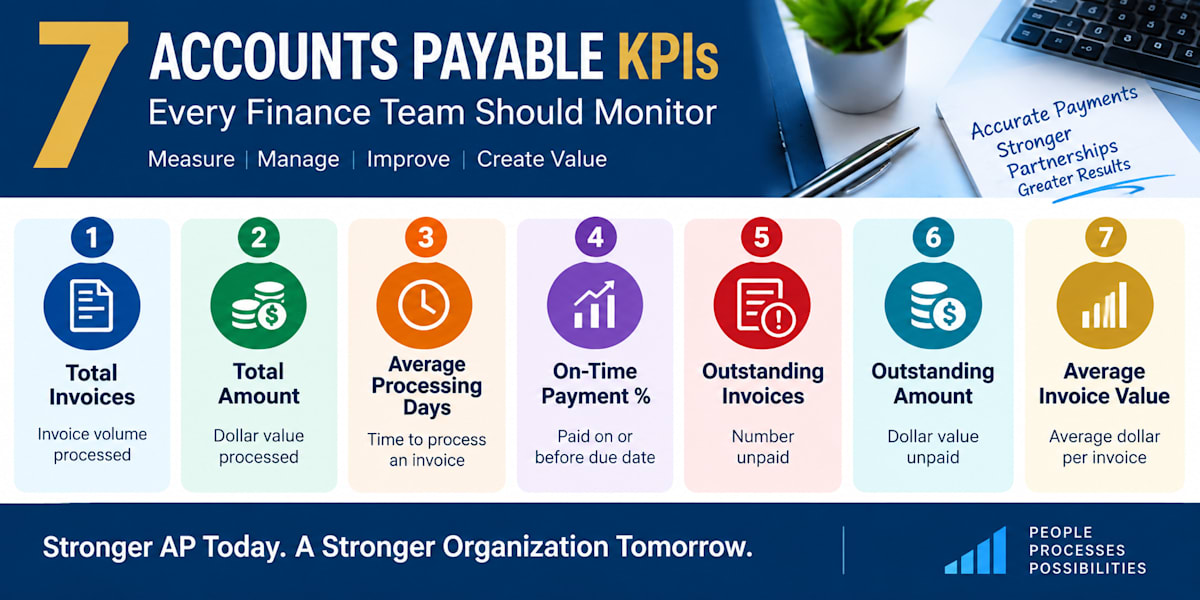
Accounts Payable (AP) is more than processing invoices and issuing payments. It plays an important role in cash-flow management, vendor relationships, internal controls, financial reporting, and operational efficiency.
Monitoring the right Key Performance Indicators (KPIs) helps finance teams identify bottlenecks, measure workload, spot emerging risks, and make better decisions about process improvement.
Here are seven practical Accounts Payable KPIs every finance team should consider monitoring.
1. Total Invoices
Total Invoices measures the number of invoices processed during a specific period, such as a month, quarter, or fiscal year.
This KPI provides insight into AP transaction volume and workload. Monitoring invoice volume over time can help management identify seasonal changes, staffing requirements, and unusual increases or decreases in activity.
2. Total Amount
Total Amount represents the dollar value of invoices processed during a particular period.
While invoice count shows transaction volume, Total Amount provides the financial perspective. Monitoring both measures gives management a clearer picture of AP activity and its effect on organizational spending.
3. Average Processing Days
Average Processing Days measures how long it takes an invoice to move through the AP process.
Average Processing Days = Total Processing Days ÷ Number of Invoices Processed
Long processing times may indicate approval delays, incomplete documentation, workflow problems, or other bottlenecks. Tracking this KPI over time can help determine whether process improvements are reducing turnaround time.
4. On-Time Payment %
On-Time Payment Percentage measures the proportion of invoices paid on or before their required payment date.
On-Time Payment % = On-Time Payments ÷ Total Payments × 100
Strong on-time performance can support vendor relationships, reduce late-payment penalties, and help organizations take advantage of available payment discounts.
5. Outstanding Invoices
Outstanding Invoices measures the number of invoices that remain unpaid.
This KPI can help identify workloads that need attention. It becomes even more useful when you analyze outstanding invoices by age, payment status, department, vendor, or responsible employee.
6. Outstanding Amount
Outstanding Amount measures the total dollar value of unpaid invoices.
This KPI provides important information for liability and cash-flow management. An organization may have relatively few outstanding invoices but still have significant financial exposure if those invoices are high in value.
For this reason, Outstanding Invoices and Outstanding Amount should generally be reviewed together.
7. Average Invoice Value
Average Invoice Value measures the average dollar amount of invoices processed during a reporting period.
Average Invoice Value = Total Invoice Amount ÷ Total Number of Invoices
Changes in average invoice value can help management understand whether changes in AP spending are driven more by transaction volume or higher-value invoices.
Related Resource: Preparing for an Accounts Payable interview? Explore the complete interview guide →
Using AP KPIs Together
No single KPI provides a complete picture of Accounts Payable performance.
For example, a team may process a high number of invoices, but that does not necessarily indicate strong performance if processing time is increasing, on-time payments are declining, or outstanding invoices are accumulating.
The real value comes from viewing these KPIs together and monitoring trends over time.
A well-designed AP dashboard can help management quickly answer important questions:
• Is invoice volume increasing?
• Are invoices being processed efficiently?
• Are payments being made on time?
• How many invoices remain outstanding?
• What is the value of unpaid invoices?
• Are process improvements producing measurable results?
From Measurement to Improvement
KPIs should not exist to populate a dashboard. They should support action.
When a KPI starts moving in the wrong direction, finance teams can investigate the cause, decide whether corrective action is needed, and keep monitoring performance to see whether the change improves results.
Effective Accounts Payable performance ultimately depends on accurate data, sound internal controls, efficient workflows, appropriate technology, and informed decision-making.
Which Accounts Payable KPI does your organization rely on most—and which one do you think is often overlooked?
Continue Learning
Strengthening Accounts Payable requires more than monitoring performance measures. Effective AP operations also depend on invoice controls, reconciliations, documentation, reporting, and well-designed workflows.
For additional practical guidance, explore Mastering Accounts Payable by Elkanah Osiemo.
Want more practical AP, Excel, and career resources? Join my mailing list for new articles, tools, and book updates.